
Particle Size, Mill Type, and Added Fat Influence Flow Ability of Ground Corn
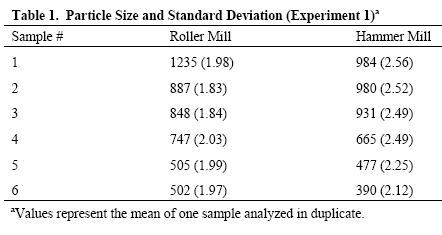
We conducted three experiments to determine effect of particle size, mill type, and added fat on flow characteristics of ground corn. In Experiment 1, corn was ground with either a hammer mill or a roller mill to produce six samples with different particle sizes. The particle size for the corn ground with a roller mill ranged from 1,235 to 502 microns with standard deviation ranging from 1.83 to 2.03. Particle size for corn ground with a hammer mill ranged from 980 to 390 microns with standard deviation ranging from 2.56 to 2.12. All samples were dried 12 hours to equalize moisture content. Soy oil was then added at 0, 2, 4, 6, and 8% to each sample.
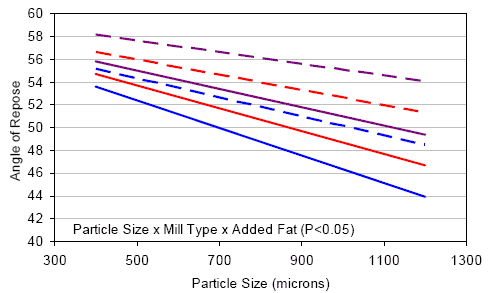
Flow ability was determined by measuring angle of repose (the maximum angle measured in degrees at which a pile of grain retains its slope). A large angle of repose represents a steeper slope and poorer flow ability. There was a three-way interaction (P<0.05) between particle size, added fat, and mill type. Roller mill ground corn had better flow ability than hammer mill ground corn, and decreasing particle size while increasing added fat, increased the angle of repose. However as particle size decreased and added fat increased, the differences between hammer mill and roller mill ground grain decreased. Corn ground with a hammer mill without added fat had a similar angle of repose to corn ground with a roller mill that had 6% added fat.
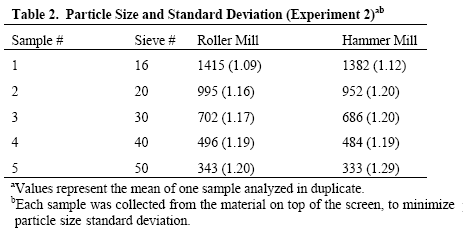
For both Experiments 2 and 3, batches of roller mill and hammer mill ground corn were sifted with a Ro-Tap tester through a stack of 13 screens. The material on top of each screen was then collected. Samples were dried 12 hours to equalize moisture content. Soy oil was added at 0, 4, and 8% to each sample. In Experiment 2, five roller mill samples were selected from different individual screens with mean particle size ranging from 1,415 to 343 microns and 5 hammer mill samples ranging from 1,382 to 333 microns. All samples were selected from the ground corn remaining on top of the individual screens. By selecting samples this way, both roller mill and hammer mill samples had similar particle size standard deviation (PSSD), ranging from 1.1 to 1.3. There was an interaction (P<0.05) between particle size, added fat, and mill type. Increasing fat and decreasing particle size increased the angle of repose. However, in fine ground hammer mill ground corn, the differences between amounts of added fat became less as particle size decreased, whereas in roller mill ground samples the differences were maintained. In roller mill ground grain samples, decreasing particle size had less negative impact on flow ability than in hammer mill ground grain.
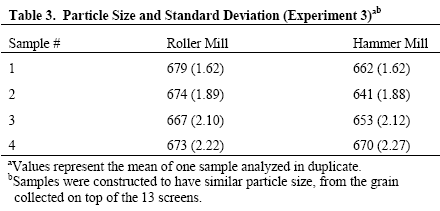
In Experiment 3, we used 4 roller mill and 4 hammer mill samples that were constructed from the previously collected grain. All samples were constructed to have a similar mean particle size (641 to 679 microns) with increasing PSSD (1.62 to 2.27). There was no interaction (P>0.10) between PSSD, added fat, and mill type. Increasing fat (P<0.04) and PSSD (P<0.001) decreased flow ability. These data suggest that the greater flow ability of roller mill ground corn compared to hammer mill ground corn appears to be a result of less particle size variation. However, with fine particle sizes other factors, such as particle shape, may also contribute to flow ability.
Introduction
Decreasing particle size between 600 and 700 microns and adding fat to diets can improve pig performance and profitability. Limits to reducing grain particle size and amount of added fat are frequently based on the ability of the feed to flow through feed delivery systems and feeders. Type of grinding may also affect feed flow ability. Grain ground with a roller mill typically has a more uniform particle size and less particle variation than that ground with a hammer mill. Therefore we conducted three experiments to evaluate the effects of particle size, added fat, mill type, and particle size standard deviation on flow characteristics of ground corn.
Procedures
All three experiments were conducted using corn ground either by a full circle, tear drop hammer mill or three high roll, roller mill at the Kansas State University Grain Science Feed Mill. The corn contained 10.3% CP and 3.2% fat on an as-fed basis. Corn was dried 12 hours to equalize moisture content, resulting in a dry matter of 96%. Particle size and standard deviation were determined with a Ro-Tap tester with a stack of 13 screens, as outlined in the American Society of Agricultural Engineers (publication S319). Angle of repose is defined as the maximum angle measured in degrees at which a pile of grain retains its slope. An angle of repose tester was constructed from 4 pieces of poly vinyl chloride (PVC). The tester is 3" in diameter and 36" tall and attached to a 3" PVC floor mounting. A 3" diameter plate was mounted to the top of the machine to allow two 3" PVC couplers that were planed to slide up and down the long axis of the tester. To conduct the angle of repose test, a 500g sample was placed inside the couplers at a specified height at the top. The base of the angle of repose tester was held stationary and the PVC couplers were lifted vertically, allowing the ground grain to flow downward, resulting in a pile on top of the plate. The height of the pile was measured, and angle of repose was calculated by the following equation, Angle of repose = tan-1 (the height of the pile divided by one half the known diameter of the plate). A larger angle of repose represents a steeper slope and poorly flowing ground grain product; a low angle of repose would represent a freer flowing product. All data were analyzed using PROC MIXED in SAS 8.1. Particle size and added fat were modeled as continuous variables with mill type as a categorical value. Parameter estimates were then output to develop the regression equations that depend on particle size, added fat, and mill type. Graphs showing modeled data were then generated.
Experiment 1. The objective was to evaluate the effects of mill type, particle size, and added fat on the flow ability of ground corn. Six different particle size samples were ground by either a hammer mill or roller mill. The particle size mean and standard deviation for the corn ground with a roller mill and hammer mill were determined (Table 1). All samples were dried 12 hours to equalize moisture content. Soy oil was then added at 0, 2, 4, 6, and 8% to portions of each sample, to give a total of 60 samples (2 mill types, 6 particle sizes, and 5 levels of added fat). Angle of repose was replicated six times within each sample.
Experiment 2. The objective was to determine if the flow differences between hammer mill ground grain and roller mill ground grain were due to the particle size standard deviation. Samples of roller mill and hammer mill ground corn were sifted with a Ro-Tap tester through a stack of 13 screens and material on top of each screen was collected. The screen number, particle size means, and particle size standard deviations for five samples of corn ground with the roller mill and five samples of corn ground with a hammer mill were determined (Table 2). Soy oil was then added at 0, 4, and 8% to portions of each sample, to give a total of 30 samples (2 mill types, 5 particle sizes, and 3 levels of added fat). Angle of repose was replicated six times within each sample.
Experiment 3. The objective was to further evaluate if the flow differences between hammer mill and roller mill ground grain were due to the particle size standard deviation. Samples of both roller mill and hammer mill corn were sifted through 13 screens, and material from each individual screen was collected. Four roller mill samples and four hammer mill samples were constructed from the grain collected to produce samples with similar particle size with increasing particle size standard deviations. The roller mill and hammer mill sample particle size and particle size standard deviations were determined (Table 3). Soy oil was then added at 0, 4, and 8% to portions of each sample, to give a total of 24 samples (2 mill types, 4 particle size standard deviations, and 3 levels of added fat). Angle of repose was replicated four times within each sample.
Results and Discussion
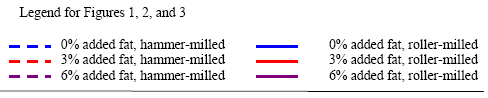
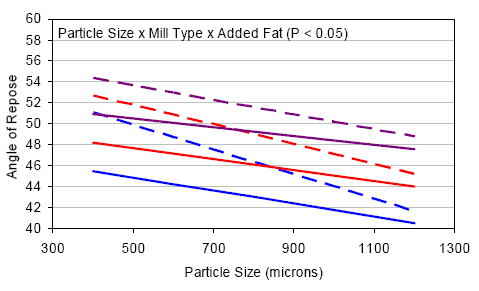
In Experiment 1 there was a three-way interaction (P<0.05) between particle size, added fat, and mill type (Figure 1). As particle size decreased and more fat was added, angle of repose increased, roller mill ground corn had a lower angle of repose than hammer milled ground grain. However, the difference between mill types, and amount of added fat, was less as particle size decreased. Corn ground with a hammer mill without added fat had a similar angle of repose to corn ground with a roller mill that had 6% added fat.
Figure 1. Effect of mill type, particle size and added fat on the flow ability of ground corn (Experiment 1).
In Experiment 2 there was a three-way interaction (P<0.05) between particle size, added fat, and mill type (Figure 2). The angle of repose increased as particle size decreased and added fat increased. However as particle size decreased, the angle of repose increased at a greater rate in hammer mill samples compared to roller mill samples.
Figure 2. Effect of particle size with narrow particle size standard deviation (1.1 to 1.3) on ground grain flow ability (Experiment 2).
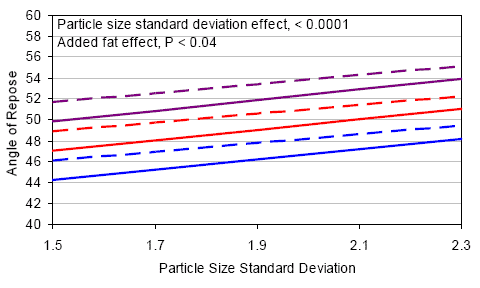
In Experiment 3 there was no interaction (P>0.10) between PSSD, added fat, and mill type. Increasing fat (P<0.04) and PSSD (P<0.001) decreased flow ability (Figure 3). When particle size and standard deviation are
equal, mill type appears to have no influence on the flow ability of the ground corn. However, because of the differences in how particle size is reduced between types of mills, grain ground with a hammer mill very frequently will have a greater standard deviation than grain ground to the same mean particle size with a roller mill.
Figure 3. Effect of particle size standard deviation on ground grain flow ability. The average particle size equal to 665 microns with increasing particle size standard deviation (Experiment 3).
In conclusion, these data suggest that the greater flow ability of roller mill ground corn appears to be largely a result of less particle size variation when compared to corn ground with a hammer mill. At fine particle sizes, particle shape also appears to contribute to differences in the flow ability of corn ground through roller mills or hammer mills. Our experiments suggest that flow ability is influenced by particle size standard deviation, particle size, and added fat.
by C.N. Groesbeck, R.D. Goodband, M.D. Tokach, J.L. Nelssen, S.S. Dritz1, K.R. Lawrence, and C.W. Hastad - Feed Processing - K-State Research and Extension, Animal Sciences & Industry
This article hasn't been commented yet.

Write a comment
* = required field